
Manassas City Property Tax Records
Manassas property tax records rest on two systems that never merge. The City Real Estate Assessment Division keeps assessed values and parcel characteristics. The Treasurer keeps real-estate tax bills and payment information. On the assessment side, the public card shows land, building, and total value fields. It also lists last-sale details. The Treasurer's public contact page confirms a separate tax-service route. The bill search and payment screens sit behind it. They are not on public display.
| Field | What It Shows | Where |
|---|---|---|
| LAND_VALUE / BLDG_VALUE | Assessment components for land and improvements | City assessment card and parcel schema |
| TOTAL_VALUE | Combined assessed parcel value | City assessment card and parcel schema |
| LAST_SALE_DATE / PRICE | Transaction display fields, not a tax balance | Assessment card and GIS parcel layer |
| Tax bill and balance | Bill and payment account details; dynamic fields not verified | City Treasurer self-service/contact route |
| Assessment notice | Current and prior two tax years of final land and improvement values | Assessment-change notice under Virginia law |
Virginia's Constitution prescribes fair market value as the assessment standard. Even so, an assessed value is still a tax record. It is not a promise of what a parcel will sell for. A recorded deed's consideration can sit far from the current assessment figure. Relief can shrink the tax owed without touching the parcel's underlying value fields. Curious how those numbers fit together? The Manassas property value page walks through the figures without treating the Treasurer's bill as a valuation. Keep appraisal, deed, and tax roll in separate mental drawers.
Manassas Assessment Search Fields
Two search routes identify a parcel on the assessment portal. Owner name is not a stated search mode. Even so, an owner field may appear on a result. This can happen when the name is not suppressed. The portal publishes no exact field labels, formatting rules, or partial-match behavior. So plan on trying both routes before concluding a parcel is missing.
| Published Search Key | Type | What Is Verified |
|---|---|---|
| Property address | Text | City says the residential and commercial assessment data is searchable by address |
| Assessment account | Text | City says an account number can be used; the displayed format was not captured |
| Owner name | Not listed as a search key | Owner information can appear on a result and may be suppressed from internet display |
Owner information updates monthly, the portal says. For anything fresher, the assessment office is the direct source. A tax bill is a different errand entirely: take it to the Treasurer rather than hunting the assessment card for payment fields that do not exist there.
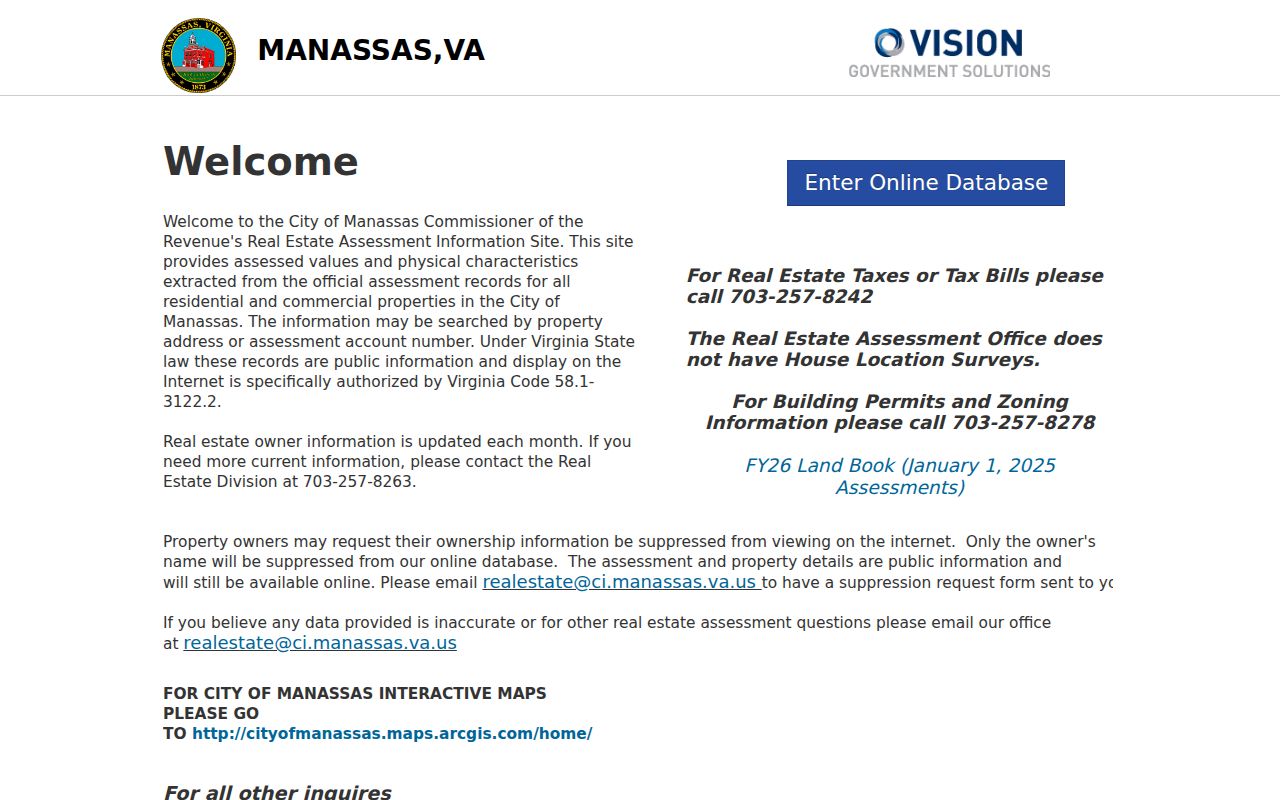
The Manassas assessment portal states its address and account search routes and links the FY26 land book.
Manassas FY26 Assessment Date
The Manassas portal links an FY26 land book. It stamps the assessment date as January 1, 2025. That date anchors the value record. It is not a payment date. It does not turn the displayed value into a live market quote either. Keep the fiscal year and assessment date beside any figure copied from the card. The land and building values stay tied to that published cycle.
Owner names refresh on a monthly schedule instead. One field can change while the assessment year holds still. That gap explains a familiar puzzle. A new sale may already sit in the deed records while the owner display lags behind. The tax roll's valuation date does not move until the next land book does.
Manassas Tax Bill Route
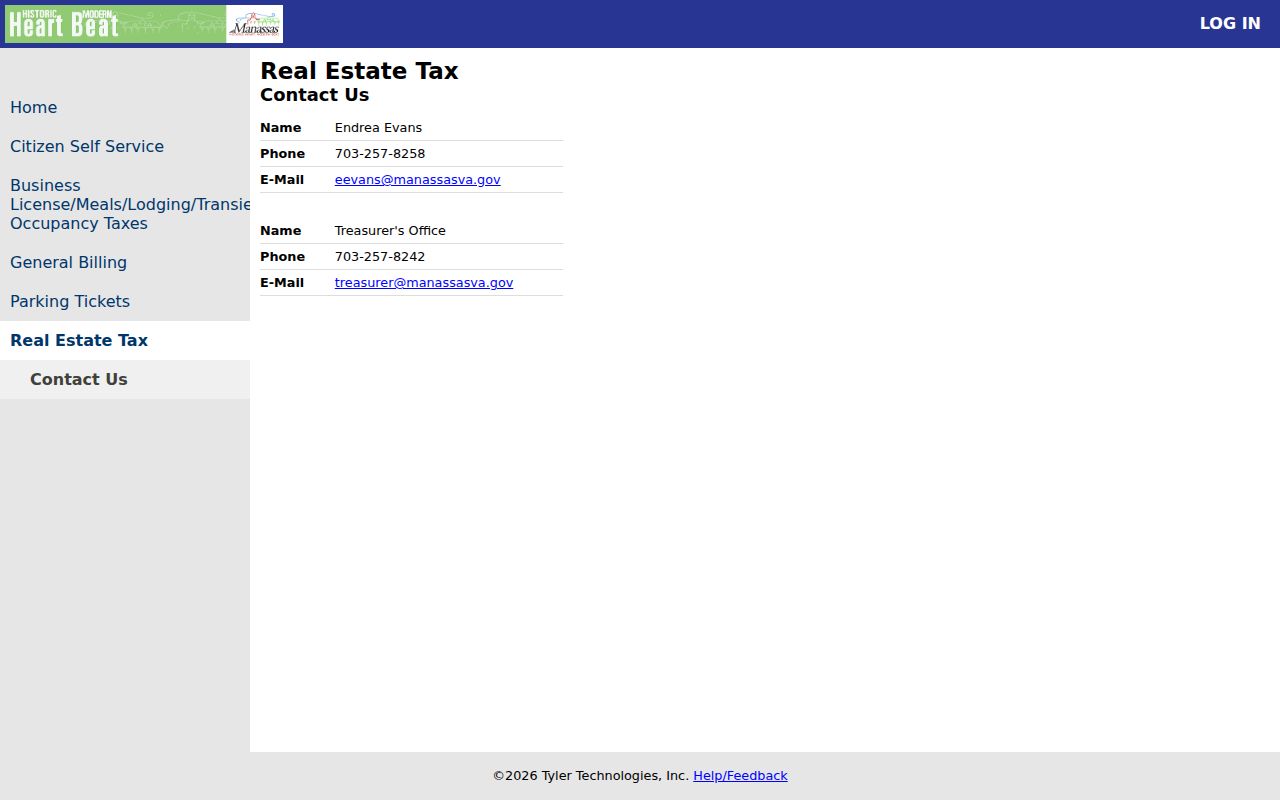
For a bill or payment question, the City's real-estate tax self-service contact page is the starting point. The bill-search fields and payment screens sit within that self-service route rather than on a public index page, so their exact layout stays unknown until you enter. The assessor portal handles no bill lookup. The Treasurer's Office answers at 703-257-8242 or treasurer@manassasva.gov.
Keep the two questions apart. Assessment issues belong to Real Estate Assessment. Tax-account issues belong to the Treasurer, whose contact page also lists an assessment contact for stray questions. When a dynamic page will not yield a bill screen, a delinquency view, or a payment history, call the office rather than guessing from another system.
- Open the City’s real-estate tax self-service contact page and follow its current bill or payment path.
- If the online route does not expose the account detail, call the Treasurer at 703-257-8242 or email treasurer@manassasva.gov.
- Use the assessor portal separately for the parcel’s assessment components and assessment date.
- For a claimed delinquency or tax sale, verify the Treasurer account and the later court or land instrument before concluding a transfer occurred.
- Assessed value
- The parcel value carried for assessment under Virginia’s fair-market-value standard.
- Tax bill
- The Treasurer’s account record for billed property tax and payment status.
- Assessment notice
- A notice that includes final assessed land and improvement values for the current and prior two tax years.
- Tax lien
- A recorded or statutory claim associated with unpaid tax; confirm the underlying record before drawing a title conclusion.
Manassas Treasurer Contact
The Treasurer's contact points are 703-257-8242 and treasurer@manassasva.gov. The City also publishes a separate real-estate tax self-service contact page. Its public text confirms the office route. But it does not confirm the screen fields, payment buttons, or years of bill history behind it. A result that never surfaces online belongs with the office. Do not reconstruct it from another system's numbers.
The Manassas real-estate tax contact page lists the Treasurer and assessment contact paths.
Virginia Assessment Review Material
Virginia Code §58.1-3331 gives taxpayers access to appraisal cards and working papers behind an assessed value, minus any confidential material. Authorized representatives get the same access. The assessor must make the valuation method available on request. That includes comparable properties and sales, market surveys, formulas, matrices, and any other factors considered. The assessor can also explain an increase in writing.
Where a limited inspection period applies, the statute sets a floor of four hours per day, Monday through Friday. That floor applies while the office is open. Treat this as a route for examining assessment support. It is no shortcut to a tax balance or a sale appraisal.
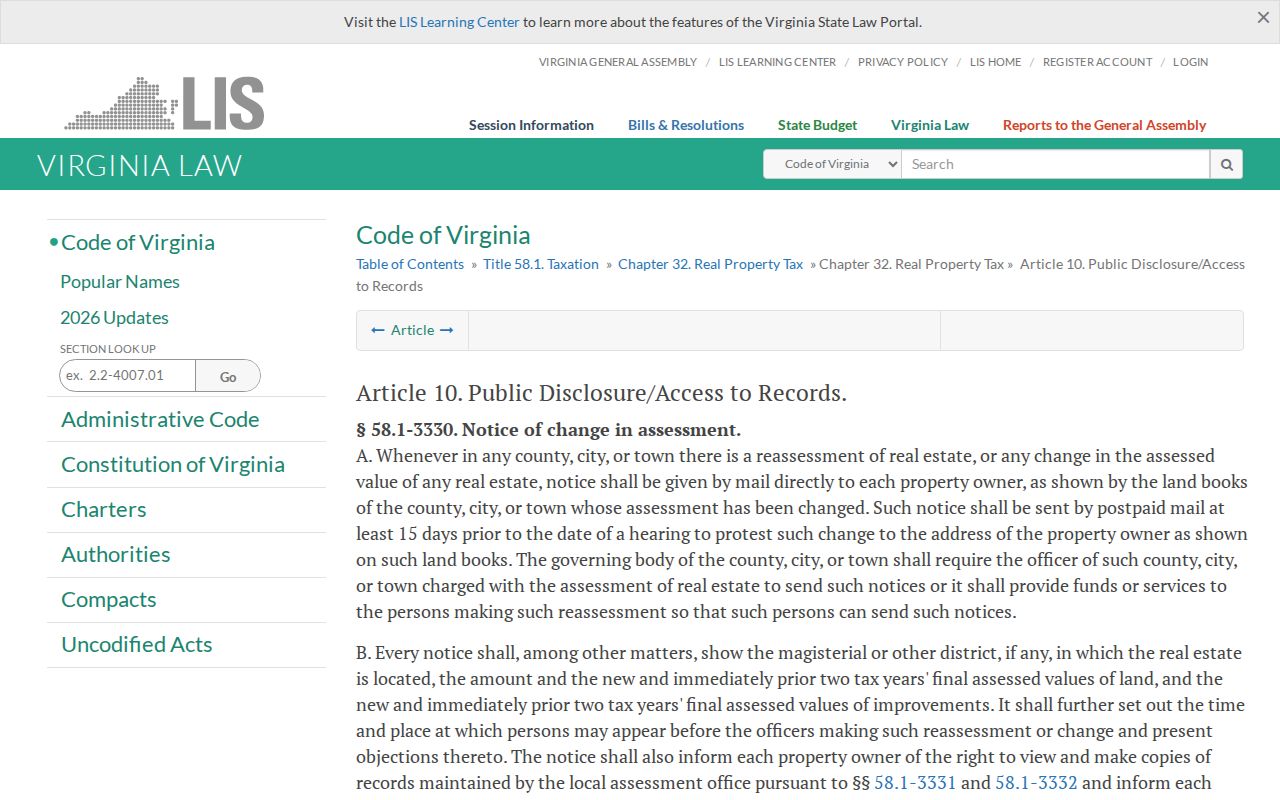
The Virginia assessment disclosure statute describes access to cards, working papers, and methodology.
Manassas Assessment Change Notice
Virginia Code §58.1-3330 sets what the notice must show. It requires final assessed land and improvement values for the current tax year plus the prior two years, along with protest or hearing information. Those columns give an owner a year-by-year comparison when a value moves. File the notice with the parcel card and any working-paper request.
Identify the parcel and its assessment date. If a number looks out of line, ask the assessment office how its method and comparable sales support the figure. The notice itself, or current office instructions, carries the local appeal deadline for Manassas. Use those rather than a guessed date.
Manassas Assessment Appeal Evidence
Start a Manassas assessment appeal with the official notice. It carries the values the City relied on. The notice must also explain how to protest or request a hearing. Treat any deadline you find online with caution. Old dates from another locality do not apply here. Ask the Real Estate Assessment Division for the current procedure, and keep the notice that matches your parcel.
Several documents can strengthen a review. The appraisal card, working papers, and the valuation method all help, as do comparable properties and recent sales. Virginia Code §58.1-3331 spells out how taxpayers or authorized representatives may examine that material. A recorded sale can serve as a comparison, but remember it is a single transaction. It may not match your parcel's condition, use, or date.
Confirm the deadline. The local appeal calendar was not verified in the research. Read the Manassas assessment-change notice and contact the City assessment office for the current protest or hearing steps before filing.
Tax Delinquency and Transfers
A delinquent Treasurer account does not mean the property was sold. A foreclosure notice is not a completed conveyance either. Look for the later order or deed that the sale actually requires. Search the court or land-record system, then compare its legal description against the assessment parcel. A monthly update may not have landed yet. The assessment roll may still list the former owner of record.
Tax-sale and foreclosure questions call for three separate records. Separate the tax bill, the case docket, and the recorded deed. The City Treasurer handles tax account questions. Virginia case information offers a party-oriented docket route. The shared clerk index records instruments. Each source proves a different step in the transfer trail.
Use the Bill Account for Payment Questions
Payment questions belong on the real-estate tax self-service page. It shows account balances, payment status, and bill details directly. A GIS map value field will not confirm a posted payment. An assessment search cannot resolve a receipt or balance discrepancy either. Contact the Treasurer with your parcel number, account details, and the bill period in hand.
The dynamic bill portal changes its fields over time. The live account page shows the current layout and payment options. For a value or property-characteristic dispute, contact the Real Estate Assessment Office instead. A recent transfer may lag behind the account. Compare the recorded deed date with the assessment roll's monthly refresh. Then ask the custodian to correct the account.